
Introducing Methodology in the Social Sciences: Principles and Practice of Structural Equation Modeling
A converged model can still be difficult to defend theoretically. Rex B. Kline’s Principles and Practice of Structural Equation Modeling, third edition (2011), is useful when drawing a diagram and obtaining output no longer seem sufficient. It connects foundations with analytical judgment.
Start reading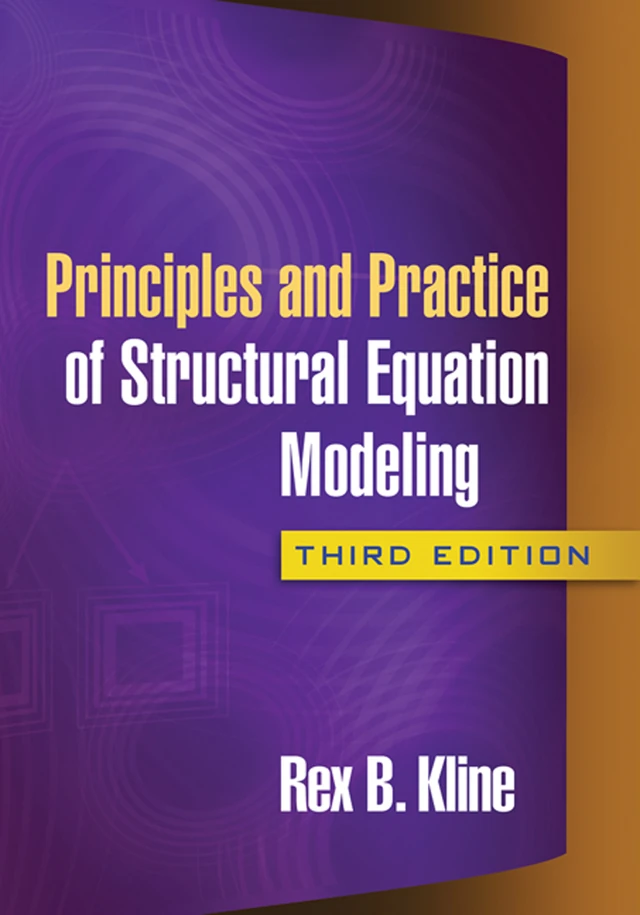
Principles and Practice of Structural Equation Modeling
Methodology in the Social Sciences
The Guilford Press · Third edition · 2011 · EnglishISBN 9781606238769Original book cover; the language and edition are identified alongside it.
Establish the groundwork
Early coverage includes regression, correlations, testing, bootstrapping and data preparation. Input forms, positive definiteness and screening help readers understand problems that can arise before fit assessment begins.
The preface emphasizes self-study through questions, exercises and reproducible examples. Use those opportunities to test whether you can explain a concept, not merely recognize its name. That distinction becomes important when justifying fixed parameters or added paths.
Keep judgment alongside software
The discussion of computer tools cautions against surrendering judgment to ease of use. An AMOS or lavaan reader can apply that stance to warnings and estimation choices: understand the problem rather than merely making its message disappear.
Separate specification, data quality and parameter meaning. A statistic may address one concern without validating the whole argument.
Suggested exercise created by Lê Minh: draw a hypothetical two-factor CFA model, assign indicators and explain each scaling constraint before estimation. Use illustrative data to inspect the results, without presenting the exercise as empirical research. Keep a notebook linking concepts, assumptions and software decisions.
Which Kline edition is this?
This article concerns the 2011 third edition, ISBN 9781606238769. The website separately introduces the 2023 fifth edition; they should not be mistaken for the same updated resource. The third edition can support foundational reading or an existing course, but a new project requires current methodological and reporting references. Its attraction is learning to question a model carefully, not preserving every instruction from 2011.
Choose a companion reading
Continue with: Principles and Practice of Structural Equation Modeling (Fifth edition · 2023 · English).
Source and edition
Kline, R. B. (2011). Principles and practice of structural equation modeling (3rd ed.). Guilford Press.