
Measurement Models and Structural Models in SEM
The measurement model asks how constructs are measured; the structural model asks how constructs relate to each other. Assess these two layers separately before combining them into SEM conclusions.
The measurement model connects constructs to indicators; the structural model connects constructs to one another. Assessment criteria vary by reflective/formative measurement type and the CB-SEM/PLS-SEM framework.
SEM combines measurement and structure
- Indicators
Observed variables in the data
- Constructs
The concepts being measured
- Measurement
Links between constructs and indicators
- Structural relations
Hypothesised links among constructs
Conceptual diagram. Assess measurement before interpreting structural relationships.
Source: Lê Minh · Conceptual illustration, not software output.1. Two Theoretical Layers Within an SEM Model
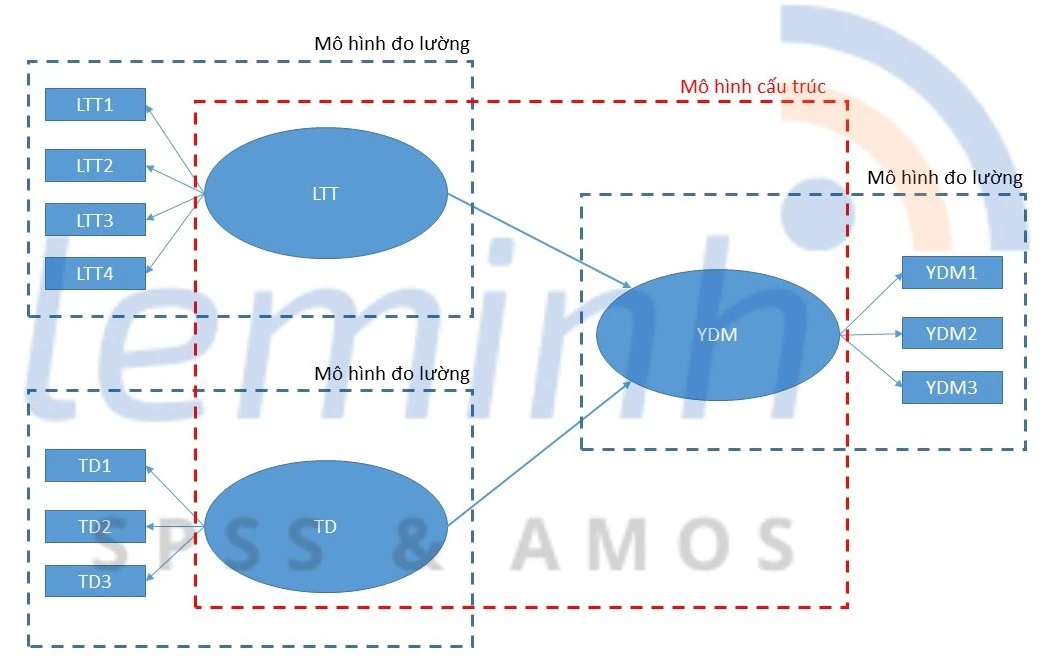
The measurement model represents relationships between theoretical concepts and observed indicators. Each construct has its own measurement specification. The structural model represents hypothesized relationships among constructs, such as X → M → Y (Henseler & Schuberth, 2020; Hair et al., 2022).
If measurement is unreliable, structural coefficients are difficult to interpret because X or Y may not adequately represent its intended concept. Most SEM workflows therefore assess measurement before drawing conclusions about paths.
| Layer | Relationship | Main question |
|---|---|---|
| Measurement | Construct ↔ indicator | Do the indicators adequately represent the concept? |
| Structural | Construct → construct | Are the hypotheses about relationships among concepts supported? |
2. Reflective and Formative Measurement Require Different Checklists
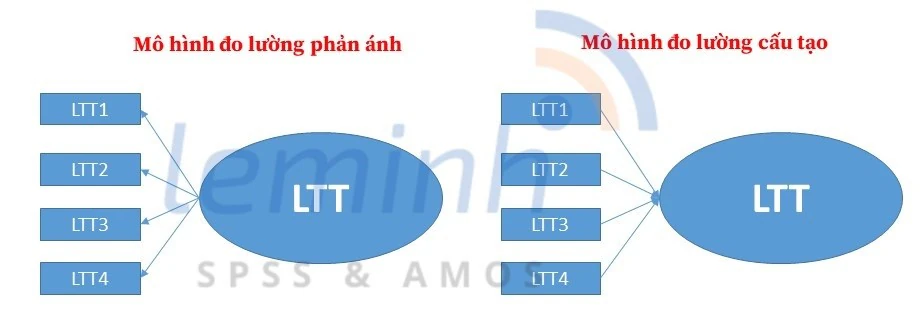
In reflective models, the construct is assumed to cause indicator variation; indicators are usually correlated and relatively interchangeable. In formative models, indicators contribute to forming the construct, and removing one can alter its conceptual domain.
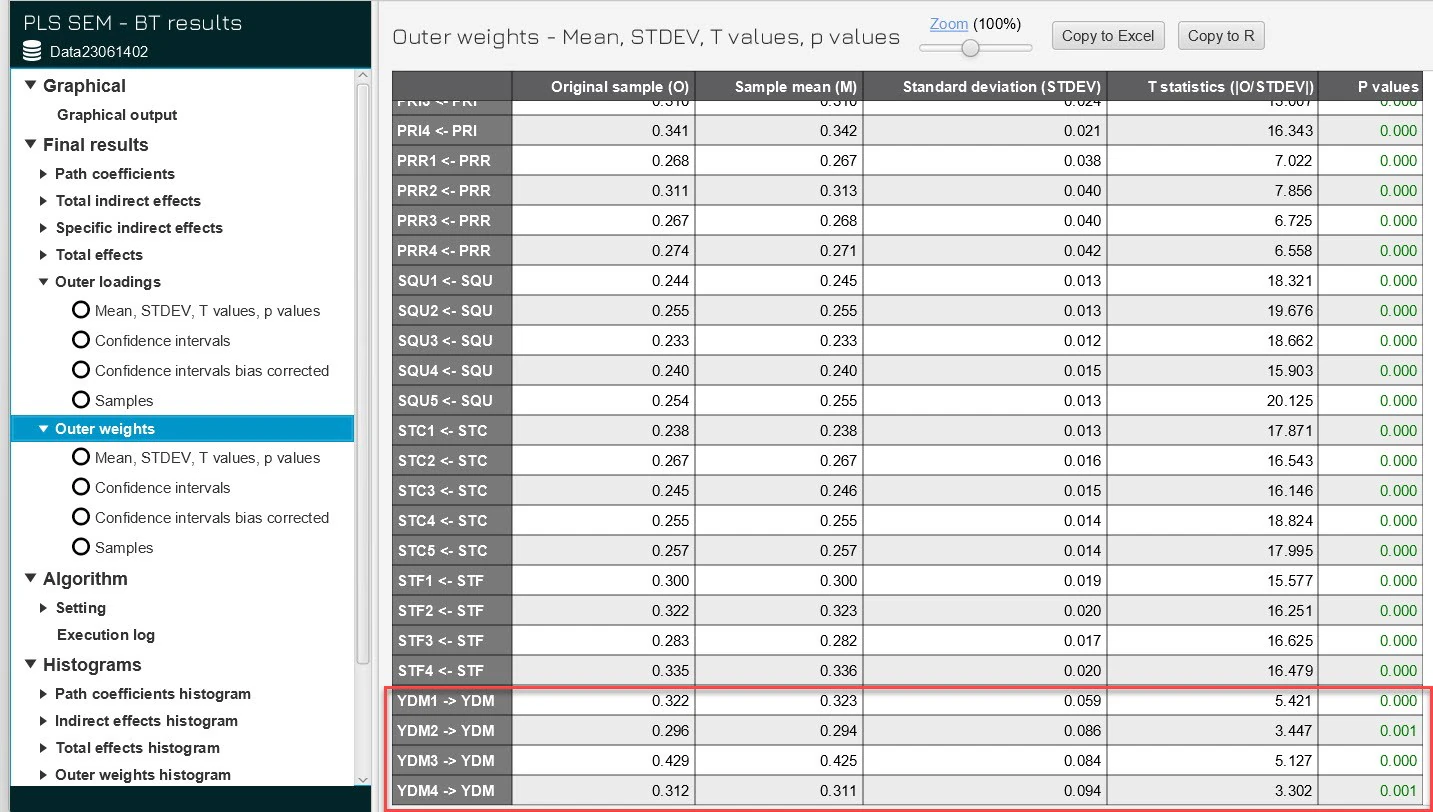
Reflective models are typically assessed using loadings, reliability, convergent validity, and discriminant validity. Formative models focus on indicator content, collinearity, and the significance and magnitude of outer weights; formative indicators should not be removed using Cronbach’s alpha logic.
Do not change reflective measurement to formative merely to improve results. Base the decision on the concept’s nature, causal relationships, and the consequences of removing indicators.
3. How Do CB-SEM and PLS-SEM Assessments Differ?
Identical index names do not guarantee identical meanings across frameworks. For example, fit in common-factor and composite models reflects different estimation objectives.
| Component | CB-SEM | PLS-SEM |
|---|---|---|
| Reflective measurement | CFA, loadings, CR/AVE, discriminant validity, fit | Loadings, ρA/CR, AVE, HTMT |
| Formative measurement | Can be modeled but requires appropriate identification | VIF, outer weights/loadings, and redundancy analysis when available |
| Structural | Overall fit, coefficients, CIs, residuals | Collinearity, coefficients, f², R², out-of-sample prediction |
| Objective | Covariance reproduction and model testing | Composite estimation and prediction/explanation |
4. An Ordered Assessment Workflow
Finalize specification
Identify constructs, measurement types, indicators, and hypotheses before examining results.
Check the data and solution
Examine missing data, outliers, distributions, identification, and estimation warnings.
Assess the measurement model
Use criteria suited to reflective/formative measurement and the SEM method.
Assess the structural model
Interpret coefficients, CIs, effect sizes, explanatory power, or prediction.
Assess robustness
Compare plausible specifications, control variables, sensitivity analyses, and validation samples where possible.
5. Reporting Template
Example report
The measurement model comprised [number] [reflective/formative] constructs. [CFA/PLS-SEM] results indicated [summary of loadings, reliability, convergent and discriminant validity, or outer weights]. After the measurement model met the requirements, the structural model was assessed using [fit/coefficients/R²/f²/PLSpredict], indicating [main results]. Indicator-removal and respecification decisions were based on [theory and diagnostics].
- Identify each construct as reflective or formative.
- Do not mix measurement criteria with structural criteria.
- Do not interpret paths before assessing measurement.
- Do not remove indicators solely on the basis of one threshold.
- Report criteria appropriate to CB-SEM or PLS-SEM.
Conclusion
Distinguishing the two model layers gives SEM reporting a logical structure: first establish that measurement is sufficiently convincing, then interpret relationships among concepts.
References
- Henseler, J., & Schuberth, F. (2020). Using confirmatory composite analysis to assess emergent variables in business research. Journal of Business Research, 120, 147–156.https://doi.org/10.1016/j.jbusres.2020.07.026
- Hair, J. F., Hult, G. T. M., Ringle, C. M., & Sarstedt, M. (2022). A primer on partial least squares structural equation modeling (PLS-SEM) (3rd ed.). SAGE.https://us.sagepub.com/en-us/nam/a-primer-on-partial-least-squares-structural-equation-modeling-pls-sem/book270548
Academic note: Common-factor, composite, and causal-formative measurement models have different assumptions. Identify the construct type correctly rather than treating reflective/formative as software labels.