
Introducing A Primer on Partial Least Squares Structural Equation Modeling (PLS-SEM)
Running a model and defending it are different tasks. The third edition of A Primer on Partial Least Squares Structural Equation Modeling by Hair and colleagues (2022) is useful at that intersection: what is being measured, which relationships are estimated and what conclusions the evidence supports.
Start reading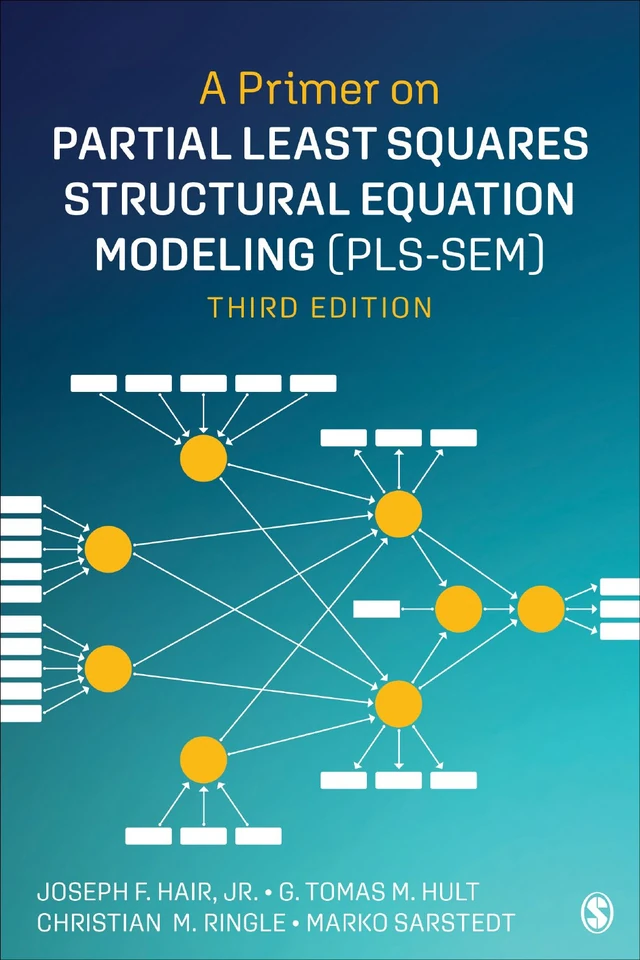
A Primer on Partial Least Squares Structural Equation Modeling (PLS-SEM)
SAGE · Third edition · EnglishISBN 9781544396408Original book cover; the language and edition are identified alongside it.
Build the sequence before adding complexity
The contents move from SEM foundations and data examination to estimation, separate assessments of reflective and formative measurement, structural assessment, mediation and moderation. That sequence makes the Primer a foundation text rather than merely a place to look up a problematic statistic.
Read the reflective/formative distinction particularly carefully. Similar-looking groups of indicators can embody different measurement arguments. Applying a familiar reliability checklist to every construct can therefore lead to poorly justified decisions.
Read toward a defensible decision
Connect each section to a small output: a diagram with construct definitions, a measurement-assessment table or a paragraph interpreting structural relationships. For every criterion, record both its purpose and what it cannot establish. Explained variance, a path coefficient and predictive performance should not collapse into an undifferentiated claim that a model is “good.”
Exercise created by Lê Minh: use a hypothetical trust–satisfaction–loyalty model. Define constructs and indicator assignments before estimation. Then justify one indicator decision using meaning as well as numerical results. The exercise is illustrative, not empirical evidence.
Write measurement and structural findings in separate paragraphs. If the same sentence seems to explain both, revisit their different roles.
Choose the right companion
The Primer suits newcomers and software users seeking stronger methodological reasoning. Readers needing reproducible code can continue with the R workbook; those investigating segmentation or higher-order models can consult Advanced Issues. This review concerns the third edition carrying a 2022 copyright date. Current software behavior requires current documentation. Its lasting attraction is a decision framework that is more useful than memorizing where a button appears.
Choose a companion reading
Continue with: Partial Least Squares Structural Equation Modeling (PLS-SEM) Using R (2021 · English edition); Advanced Issues in Partial Least Squares Structural Equation Modeling (First edition · 2018 · English).
Source and edition
Hair, J. F., Jr., Hult, G. T. M., Ringle, C. M., & Sarstedt, M. (2022). A primer on partial least squares structural equation modeling (PLS-SEM) (3rd ed.). SAGE.