
Introducing Partial Least Squares Structural Equation Modeling (PLS-SEM) Using R
A polished table still leaves a practical question: can you recreate it from the original data? PLS-SEM Using R: A Workbook by Hair and colleagues (2021) makes analysis readable and repeatable through code. For RStudio users, that is a concrete bridge between methodological knowledge and an inspectable analytical record.
Start reading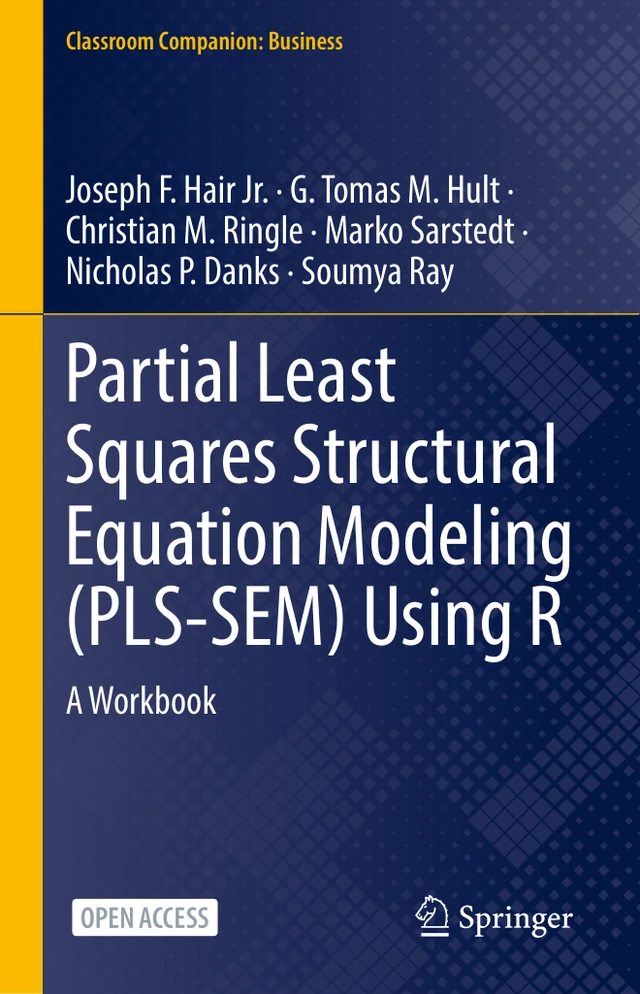
Partial Least Squares Structural Equation Modeling (PLS-SEM) Using R
A Workbook
Springer · 2021 · English editionISBN 9783030805197Original book cover; the language and edition are identified alongside it.
Why choose a workbook
The preface emphasizes a case-based introduction to R and SEMinR, obtaining solutions and reporting them. Coverage includes reliability, discriminant validity, bootstrap assessment and PLSpredict. Model design and measurement specification receive less emphasis than in a foundation text.
Code does not make a study automatically sound. It makes choices visible: indicator assignments, structural relationships and the procedures executed. Readers can revisit a questionable choice instead of retaining only its final table.
Work inside a small RStudio project
Keep data, scripts and results organized. Run examples in sections and inspect returned objects. Once an example works, alter one justified choice and document its consequences. This is more instructive than pasting an entire script and checking only for successful execution.
Readers of the Primer can use the workbook for practice; newcomers should study measurement reasoning alongside it. SEMinR syntax cannot decide whether a construct should be reflective or formative.
Suggested exercise created by Lê Minh: close RStudio, reopen the project in a clean session and regenerate the illustrative results from saved scripts. Record R and package versions, seed and missing-data treatment. This is a reproducibility exercise, not a promise of identical bootstrap digits across environments.
Access and limits
The book is suitable for students, teaching and reproducible analysis. Springer provides open access through its publication page. Because it appeared in 2021, package interfaces and defaults need checking against current help files. Preserve session information. The worthwhile goal is understanding and documenting decisions, even when a current environment requires syntax changes.
Choose a companion reading
Continue with: A Primer on Partial Least Squares Structural Equation Modeling (PLS-SEM) (Third edition · English).
Source and edition
Hair, J. F., Jr., Hult, G. T. M., Ringle, C. M., Sarstedt, M., Danks, N. P., & Ray, S. (2021). Partial least squares structural equation modeling (PLS-SEM) using R: A workbook. Springer. https://doi.org/10.1007/978-3-030-80519-7